School excursion approval is far more involved than deciding on where students should go and when they should go there. There are other considerations, like student safety, educational purpose, staff duties, transportation, cost, accessibility, and parent information, that have to be considered together. All of this tends to make the whole process quite complicated.
The good news is that having a system for approving an excursion will make the planning process far simpler. Regardless of whether the school organises a day trip or an excursion in Australia, a good checklist will be helpful in determining any problems that may arise and making wise decisions.
Here is a guide to what needs to be checked before the excursion is approved.
Start by Looking at the Purpose of the Excursion
Before reviewing the practical details, administrators should first understand why the excursion has been proposed.
The purpose of the school trip should be clearly defined. This does not necessarily mean that there is going to be only one subject to which the trip will relate, but students should have some reason to join other than just being absent from school for a day.
For instance, if students go to a museum, then they may learn something about the history unit they are currently studying, and if they visit an environmental center, they can enrich their knowledge of science or geography. Cultural events can enable students to study Australian history and identity and different views on it.
Here are some questions to consider:
- What will students learn or experience?
- How does the trip connect with classroom learning?
- Is the activity suitable for the students’ year level?
- Does the experience offer something students cannot easily gain in the classroom?
- How will teachers build on the experience afterwards?
Starting with these questions helps administrators assess the value of the excursion before getting caught up in the logistics.

Check Whether the Destination Is Suitable
When the objectives have been clarified, the next logical step would be to examine the destination more closely.
Not everything that is popular is necessarily a good fit for every student group. In order to be appropriate, the destination must cater to the age, skills, interests, and learning styles of the students in the group and offer sufficient organization so as not to bore but not become too regimented.
The administrators would want to know about the experience of the destination in hosting school groups as well as its suitability in terms of year levels, facilities, crowd management, among others. Accessibility may also be a factor when looking into the viability of the destination. Should there be students who need special assistance, the venue would be able to accommodate them as much as possible.
Research at this point will save headaches in the future.
Review the Educational Value
An excursion does not have to follow the format of a standard class to be useful and successful. Instead, sometimes the best way for students to learn is by giving them the opportunity to observe, experience, and participate in something.
The science class may take an ecological system as a subject for an excursion; the history class may visit a museum or some place with historical value. Older students may be asked to attend universities or places of work to see how their subject will be applied to their education and careers in the future.
What matters is the relevance of the event for students’ educational needs.
School administrators may demand that the teacher prove that the excursion is helpful for the Australian curriculum and that there will be opportunities for students to participate instead of just watching. The actual event can include workshops, exercises, research on location, and even interviews with experts.
It is also here that school excursions Australia can provide lots of variety. Schools could choose from the activities that help students learn academically and develop such qualities as curiosity, independence, communication, and teamwork.
Take a Closer Look at the Risk Assessment
Safety is one of the most important parts of any excursion approval process. Every trip has potential risks, but those risks will vary depending on the destination, activities, transport, and length of the excursion.
A risk assessment should therefore reflect the actual trip rather than being treated as a standard formality.
Administrators should consider what could happen from the moment students leave school until they return. This includes travel, movement between locations, outdoor activities, weather conditions, student behaviour, and medical emergencies.
Depending on the excursion, the assessment may need to address:
- Transport and road safety
- Outdoor or water-based activities
- Extreme weather
- Medical conditions and allergies
- Students becoming separated from the group
- Emergency procedures
- Supervision requirements
The goal is not to remove every possible risk. Instead, it is to understand those risks and establish sensible measures to manage them.
A thorough assessment also gives teachers and supervisors greater confidence because they know what procedures to follow if something unexpected happens.
Confirm the Supervision Plan
A level of supervision that is appropriate may have an effect on the success of the field trip.
The number of teachers required may depend on a number of factors, such as, but not limited to, the age of the kids, the number of people involved, the place of destination, and the activities planned. The duty of the administrators is to ensure that the staffing arrangement is appropriate for the field trip.
It is equally important to ensure that everyone understands what their duties are. This means that the teachers or the adult supervisors should know the responsibilities assigned to them as far as the supervision of the kids during the field trip is concerned.
For example, the teachers or the adult supervisors must decide ahead of time what duties should be performed by whom during the field trip.
Make Sure the Transport Plan Works
Transport can be one of the most challenging components of organizing a school trip, especially if the destination is far away from the place where the students come from.
Administrators have to check whether the chosen means of transport and the schedule are workable and provide sufficient time for travel.
The transport has to be capable of providing all the services required by the school and meet all the safety standards.
For long trips, administrators have to ask whether the schedule is workable. The schedule that appears to be effective on paper does not mean that the students have enough time and energy after such a busy trip.
It is better to have a schedule that provides the opportunity to go to the destination and get back home comfortably.
Look at the Full Cost
Budget considerations should be reviewed before an excursion is approved, not after families have already been informed.
The advertised price of a trip may not include every expense. Administrators should look at the complete cost, including transport, entry fees, activities, meals, accommodation, and any other charges.
It is also important to understand payment deadlines, cancellation policies, and whether refunds are available if a student is unable to attend.
Schools should consider affordability as part of the planning process. If the cost may create difficulties for some families, administrators may need to explore appropriate support options according to school policies.
The aim is to ensure the financial side of the trip is realistic for both the school and participating families.
Consider Accessibility and Inclusion From the Beginning
Accessibility cannot be an afterthought.
There are students with various physical, health, sensory, and learning needs that need to be taken into account in the early stages of planning the trip. The trip will be more effective if students can actively participate and not be excluded from activities due to the lack of proper preparations.
Administrators can verify whether the location and means of transport will allow students with special needs to participate in the trip. In some instances, it is necessary to consult with the family or care workers in order to understand how adjustments need to be made.
Sometimes it only takes a slight adjustment of the program to help a student take part in the trip.
It is also helpful to prepare in advance in order not to experience stress at the last minute.
Review Medical and Emergency Arrangements
Schools need to know how they will respond if a student becomes ill or an emergency occurs during the trip.
Before approval, administrators should confirm that current medical information and emergency contact details are available. Any medication requirements should also be clearly understood, with staff following the school’s procedures for storage and administration.
The planning process should establish how staff will handle situations such as:
- A student becoming seriously unwell
- An allergic reaction
- A medical emergency
- A student requiring urgent treatment
- Contacting parents or guardians
- Arranging emergency transport if necessary
The arrangements may be more detailed for overnight trips, interstate travel, or activities that take place far from medical facilities.
The important thing is that staff should know what to do and who is responsible for making decisions if something goes wrong.
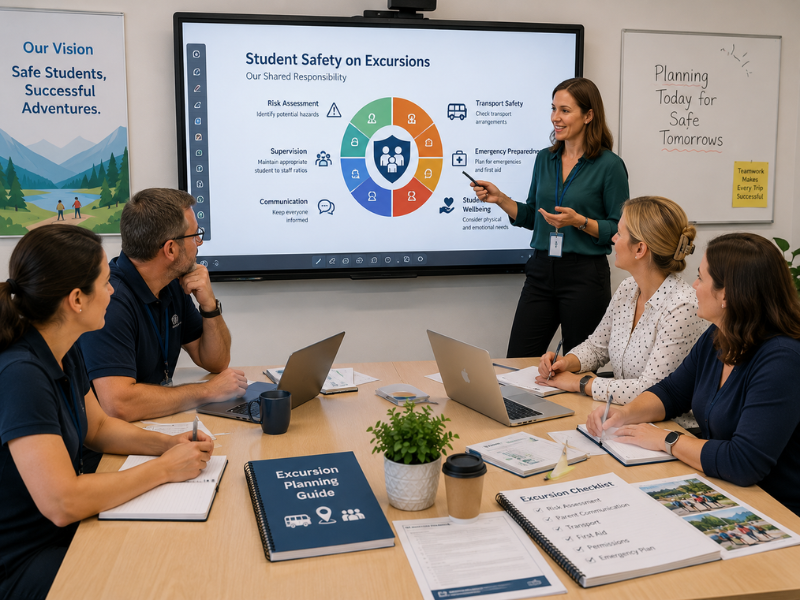
Examine the Itinerary Before Giving Approval
An appropriate plan can either make a fun tour or cause frustration for a student.
Administrators must ensure that the schedule allows ample time for traveling between destinations, resting, having lunch, etc.
Overloading the schedule of a tour is a very common error in planning.
Students can actually go to all destinations; however, there may not be enough time for them to experience the full benefit of visiting each of the places.
An effective schedule should provide adequate time not only for performing various tasks but also for solving problems with unexpected situations.
In addition, the schedule should be logical, since when students learn about some issue, activities can be organized accordingly.
Make Parent Communication Clear
Parents require adequate information to know what their children are going to do and how they should get ready for the activity.
The amount of information depends on the nature of the travel plan, but it could include things like destination, schedule, cost, transportation, clothing, food, medical, and contingency plans.
Additionally, parents should know when the students are supposed to leave and come back, and what is supposed to happen in case of any problems.
In the case of overnight activities, parents would also need other types of information, such as accommodation details and communication issues.
Proper communication minimizes uncertainties and creates confidence among parents.
Check All Required Documentation
The administrative work associated with the planning of an excursion may be rather boring, but it is very important for ensuring a successful authorization procedure.
Prior to approving an excursion, the administrators must make sure that all the required papers have been filled out. The documents that might be included in this case vary from school to school as well as from type to type of excursion risk assessment, permission slips, medical information, transportation papers, insurance papers, etc.
It is helpful to keep all this information together in one place for ease of reference by staff members.
It is necessary to comply with the school’s regulations and the regulations of the educational department.
A uniform documentation procedure helps to avoid missing anything significant.
Think About What Happens After the Trip
Learning does not always have to end once students go back to their classes.
It is easy enough to have students discuss what they observed, which helps tie the excursion to their classroom work.
The task should not be burdensome to teachers. Simply having students describe what surprised them, what new things they have learned, and what they still want to know would already prompt them to reflect on their observations.
This will also give the teacher an opportunity to determine if the objectives were met in the field trip.
A Practical School Excursion Approval Checklist
After all the necessary details are considered, an easy checklist should be completed by the administrators before making any decisions:
- Purpose: Is there a definite educational or developmental purpose of such a trip?
- Destination: Is it appropriate for the student group in question?
- Safety: Have the corresponding risks been taken into account and resolved?
- Supervision: Are there sufficient numbers of adults to supervise?
- Travel: Are there sufficient transport conditions?
- Budget: Have all the costs been calculated?
- Accessibility: Can different categories of students take part in it?
- Health needs: Is there relevant health information and medical procedure in place?
- Itinerary: Is it practical and not rushed?
- Communication: Have all parents been informed?
- Paperwork: Is all necessary documentation complete?
- Follow-up: Is there a plan to make connections to learning?
If everything is in its right place, administrators may continue their work with more assurance.

Final Thoughts
An efficient approval procedure enables schools to conduct their excursion planning in an effective way and allows them to make sure no essential thing is missed. Through checking the educational significance, safety, supervision, logistics, accessibility, and documentation, schools will be able to proceed with more assurance.
Planning an excursion for their next trip may be helpful for schools.
Administrators should review the excursion's educational purpose, risk assessment, supervision, transport, costs, accessibility, medical arrangements, and required documentation.
A risk assessment helps identify potential hazards and outlines practical steps to manage them. It should reflect the specific destination and activities planned.
A checklist should cover the destination, learning outcomes, safety, supervision, transport, budget, accessibility, medical needs, parent communication, and documentation.
Schools should consider accessibility from the beginning and check whether transport, venues, and activities can accommodate students with different physical, medical, sensory, or learning needs.
Planning should begin early enough to review safety requirements, arrange transport and supervision, complete documentation, and give families sufficient time to prepare.
