Sometimes lessons become clearer when students can visualize, feel, and experience what they’ve been learning about. For example, a tour to a farm will provide the understanding of how food was produced, while a visit to the museum would help students to get insights about historical events. This is why educational excursions tours offered by Australia are important for schools, since students can connect what they learn in class to real-world situations and people.
The tours that will not be remembered by the students do not have long itineraries but rather something interesting for them to explore and think about.
Why Do Students Learn Differently Outside the Classroom?
Classroom teaching provides essential knowledge, but some concepts become clearer when students encounter them in real situations. Seeing geological formations, examining historical objects or observing wildlife helps turn abstract information into something students can understand.
Outdoor and experiential learning can also encourage students to take a more active role. Instead of listening to an explanation, they can investigate, compare evidence, ask questions and discuss what they discover.
A well-planned visit can help students develop:
- Observation and critical-thinking skills
- Communication and teamwork
- Problem-solving abilities
- Environmental awareness
- Cultural understanding
- Confidence and independence
The Australian Curriculum recognises outdoor learning as an opportunity to develop knowledge, skills and positive relationships with natural environments. It can contribute to several learning areas rather than being limited to outdoor education alone.
What Makes Educational Excursions Australia Suitable for Different Subjects?
Australia’s geographical and cultural diversity gives teachers many ways to connect destinations with classroom topics. A single location can support several subjects, provided the activities are selected around clear learning outcomes.
For example, a visit to a national park may involve geography, biology and sustainability, while a heritage destination can connect history, economics and civics.
The following destination types offer different learning opportunities.
Which Destinations Help Students Connect Theory With Practice?
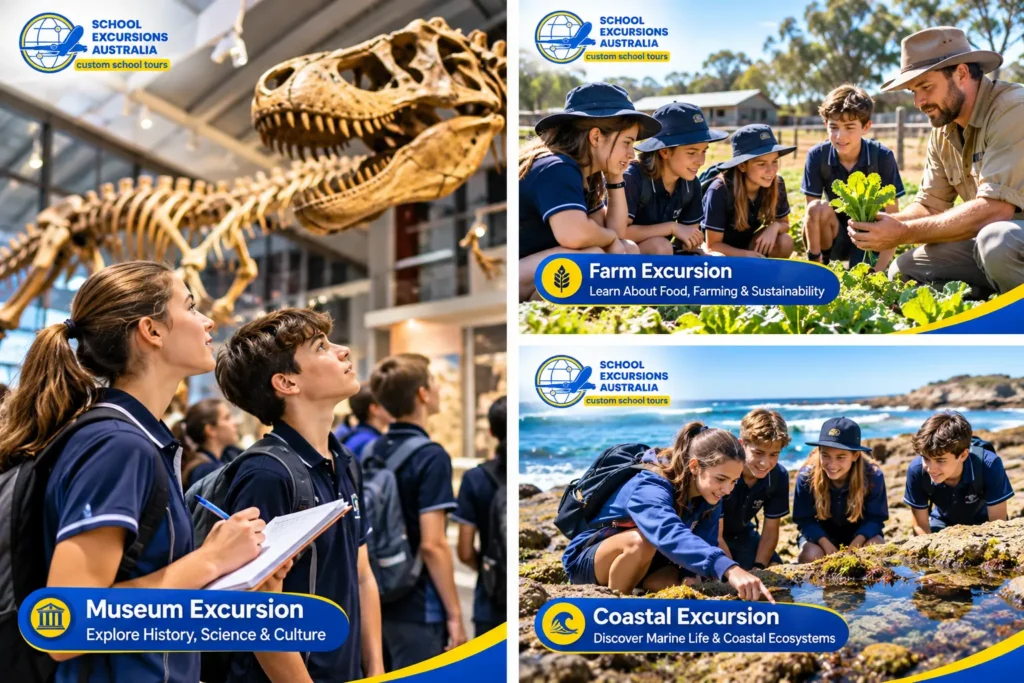
National parks provide opportunities to study ecosystems, biodiversity, landforms and conservation. Students can observe how plants and animals adapt to their surroundings and investigate the effects of human activity on natural habitats.
Activities might include:
- Identifying native plants and animal habitats
- Comparing vegetation across different environments
- Observing erosion and water movement
- Studying conservation and habitat protection
- Recording environmental changes through field sketches
For example, the Blue Mountains offer opportunities to examine sandstone formations, native vegetation and the relationship between tourism and environmental management.
Why Are Museums Valuable for Historical and Scientific Learning?
Museums allow students to explore objects, specimens, documents and demonstrations that may be difficult to access at school.
A history visit can introduce primary sources and different perspectives on past events. Science exhibitions can help students investigate fossils, ecosystems, technology and human development.
The Australian Museum in Sydney offers educator-led programs covering science, First Nations perspectives and history, alongside self-guided gallery visits. Its programs include hands-on activities and opportunities to examine real collections.
Students can make better use of these visits when teachers provide a small number of questions to investigate rather than asking them to record information from every exhibition.
What Can Farms Teach Students About Food Production?
Working farms and agricultural centres can introduce students to the processes behind everyday food products. They can explore how crops are grown, how animals are cared for and how weather, soil and water influence agricultural production.
A farm visit may include:
- Understanding the journey from farm to consumer
- Examining soil types and irrigation
- Learning about sustainable farming practices
- Observing animal care and welfare
- Exploring machinery and agricultural technology
These experiences can connect science, geography, technology and economics. Students can also consider how farming communities respond to changing environmental and market conditions.
How Can Coastal Destinations Introduce Marine Science?
Coastal environments provide practical opportunities to investigate marine ecosystems, water quality, erosion and biodiversity.
A visit to Exmouth and Ningaloo Reef can introduce students to coral ecosystems, marine food webs and conservation. Students can observe habitat features, examine marine life through guided activities and learn why responsible tourism matters.
Not every marine investigation requires students to enter the water. Shoreline observations, underwater videos, glass-bottom boat experiences and marine identification activities can provide alternative ways to participate.
How Can Cultural Experiences Make Learning More Meaningful?
Learning about Australian history and culture requires more than reading historical accounts. Visiting culturally significant places and engaging with appropriate educators can help students understand how people, communities and traditions shape the country.
First Nations learning should be developed with appropriate cultural authority and should recognise the continuing connections between Aboriginal and Torres Strait Islander peoples, Country, culture and community.
Depending on the destination, students may explore:
- Traditional knowledge of plants and natural resources
- The significance of Country and waterways
- Historical changes following European settlement
- Cultural objects, artworks and storytelling
- The importance of protecting cultural heritage
For example, a visit to a cultural institution can introduce students to objects and stories through educator-led interpretation. The Australian Museum’s Sea Country program provides an opportunity to explore First Nations perspectives through stories, objects and artworks.
The Australian Museum+1
The important consideration is to avoid presenting culture as a collection of interesting facts. Students should understand the context, continuing significance and appropriate protocols surrounding what they learn.
What Makes a School Trip Memorable Rather Than Just Entertaining?
An enjoyable activity can make a trip exciting, but enjoyment alone does not guarantee meaningful learning. Students need opportunities to connect the experience with something they have already studied or will investigate afterwards.
A useful approach is to organise activities around one central question.
For example, during a wildlife visit, students might investigate:
What does an animal need to survive in its natural habitat?
They could observe its physical features, examine its food sources and identify possible threats to its environment.
This gives the activity a clear purpose and encourages students to think beyond simply seeing an animal.
A memorable experience usually includes three elements:
- Discovery: Students encounter something new or unfamiliar.
- Participation: They actively observe, investigate or contribute.
- Reflection: They explain what they learned and why it matters.
This combination makes the experience more valuable than an itinerary filled with disconnected attractions.
How Can Teachers Connect an Excursion With Classroom Learning?
An excursion should be part of a broader teaching plan, not an isolated day away from school.
What Should Students Learn Before Departure?
Preparation gives students enough background to understand what they will encounter.
Teachers can introduce:
- The destination and its geographical setting
- Important historical or environmental context
- Key vocabulary and concepts
- Questions they should investigate
- Expected behaviour and site requirements
For example, students visiting a goldfields destination could first study the Victorian Gold Rush. During the visit, they can examine mining methods and historical buildings. Afterwards, they can compare their classroom understanding with the evidence they encountered.
What Activities Should Students Complete During the Visit?
Field activities should be simple and relevant. Too many worksheets can distract students from the actual experience.
Useful activities include:
- Recording observations in a field notebook
- Sketching a landscape or historical structure
- Comparing two habitats or locations
- Asking questions during guided sessions
- Identifying evidence of environmental change
- Discussing findings in small groups
How Can Teachers Reinforce Learning Afterwards?
The follow-up lesson should ask students to interpret what they experienced.
They might prepare a short report, presentation, labelled diagram or group discussion. Teachers can also ask students which observation changed their understanding of the topic.
This final step helps turn an enjoyable day into knowledge that students can apply elsewhere.
How Can Schools Choose Educational Excursions Australia Offers?
Choosing a destination should begin with the learning objective, not its popularity. A place may look impressive, but teachers need to consider whether it offers suitable activities, age-appropriate experiences and meaningful curriculum connections.
Before confirming a destination, consider:
Selection factor | What teachers should consider |
Curriculum relevance | Does the destination support current classroom topics? |
Student age | Are activities suitable for the year level? |
Participation | Can students with different abilities take part? |
Travel time | Is there enough time for meaningful activities? |
Cost | Are transport, meals and admission within budget? |
Seasonal conditions | Will weather affect the planned experience? |
Learning resources | Are guided activities or educational materials available? |
Comparing two or three destinations against these factors can make the decision easier and prevent unnecessary travel or activities.
What Should Schools Prepare Before the Trip?
A meaningful experience also needs careful preparation. Teachers should establish the educational purpose, confirm venue arrangements and make sure students understand what to expect.
Important planning requirements include:
- Obtaining school approval
- Completing an appropriate risk assessment
- Confirming transport and supervision
- Collecting parent or carer consent
- Checking medical and accessibility requirements
- Sharing clothing and equipment instructions
- Preparing alternative activities where necessary
The NSW Department of Education’s excursion policy highlights educational value, inclusion, risk management, student needs and parent communication as important parts of excursion planning. Requirements vary between education jurisdictions, so schools should follow their own governing authority’s procedures.
How Can Schools Make Excursions More Inclusive?
Every student should have a reasonable opportunity to participate in the learning experience. This requires teachers to consider individual needs before confirming activities and venues.
For example, a walking-based environmental program may need an accessible route or an alternative observation activity. A water-based program may require a suitable land-based option for students who cannot swim.
Teachers should discuss relevant requirements with families and providers, including:
- Mobility and accessibility
- Medical conditions and medication
- Dietary requirements
- Sensory or communication support
- Physical activity levels
- Financial assistance where available
Inclusion should be part of the original itinerary rather than an adjustment made at the last minute.
What Should Teachers Look for When Comparing Providers?
A suitable destination is only one part of the experience. The organisation delivering the activities should also have the experience and resources required to work with school groups.
Before booking, ask about:
- Experience with the relevant age group
- Educator or instructor qualifications
- Activity schedules and group limits
- Insurance and safety documentation
- Accessibility arrangements
- Emergency procedures
- Cancellation conditions
- Curriculum resources
Teachers should review provider information alongside their own risk assessment. An external operator’s safety procedures do not replace the school’s responsibility for students.
Conclusion
The most meaningful trips give students opportunities to explore ideas beyond textbooks, engage with unfamiliar environments and develop a better understanding of the world around them.
When comparing educational excursions Australia offers, schools should prioritise curriculum relevance, student participation and the quality of the learning experience rather than the number of attractions included.
Teachers can explore the School Excursions Australia destination guide to shortlist suitable locations and compare experiences. From there, they can identify programs that match their teaching objectives, student requirements and available budget.
There is no fixed number. Two or three well-connected activities are often more valuable than a packed schedule with little time for observation and discussion.
Yes. The destination and activities should match the students' age, curriculum and abilities. Primary students may benefit from guided discovery, while secondary students can undertake more detailed investigations and independent research.
No. Museums, science centres, galleries and cultural institutions can provide equally valuable learning opportunities. Indoor destinations are also useful when weather makes outdoor activities unsuitable.
Teachers can assess field notes, presentations, group discussions, reports and post-visit activities. The important question is whether students can explain what they observed and connect it with their learning.
Yes. The right excursion can be adapted to suit students of different ages, learning needs and interests.
