The Coral Reef might seem like a serene ecosystem when viewed from the beach but underneath the surface, thousands of organisms compete, hunt, hide and adapt to the changing environment around them. The Ningaloo Reefs provide an environment for students to learn from nature rather than learning about coral reefs through diagrammatic studies at Exmouth school excursions.
Another useful comparison can be made through the Ningaloo Reefs. A very diversified marine environment coexists next to an arid environment like the Cape Range. In this way, the location can provide education on marine science, geography, environmental management and outdoor education without turning it into just wildlife watching.
Why is Ningaloo Reef a Strong Science Learning Environment?
The Ningaloo Reef is among the world’s biggest and most extensive offshore reef systems, stretching over 200 kilometres along Western Australia’s coastline.
The World Heritage Site at the Ningaloo Coast features lagoons, coral reefs, the open sea, rocky coasts, beaches, mangrove systems and the limestone terrain of Cape Range. The combination of these ecosystems sustains over 300 types of coral and over 700 reef fish. DCCEEW
Students will have a scientific issue to study as a result of all these diverse features:
What strategies do the organisms use to thrive in the reef community, and how does the environment help maintain this reef system?
The above question can be used to make observations from various places. For example, students can study coral anatomy in one place, fish behaviour in another, and the effects of currents along the coastline.
What Observations Can Be Made By Students on School Trips To Exmouth?
An effective fieldwork investigation should focus on relationships rather than simple species identification.
Students can investigate:
- How coral structure creates shelter
- Why different fish occupy different parts of the reef
- How sunlight and water depth affect marine life
- What adaptations help organisms survive waves and currents
- How feeding relationships form a reef food web
- Why water quality matters to coral communities
- How visitors can observe wildlife without causing disturbance
These topics can be altered according to the year level of the students. The primary class students may look at habitat and adaptation features, while the secondary school kids may analyze ecosystem interactions and biodiversity issues.
How Does a Reef Observation Become Scientific Fieldwork?
The Ningaloo Reef field trip becomes more meaningful if the students can find information in support of a specific question. The mere fact of observing the corals and fishes can be an exciting experience.
What Can Students Record Without Disturbing the Reef?
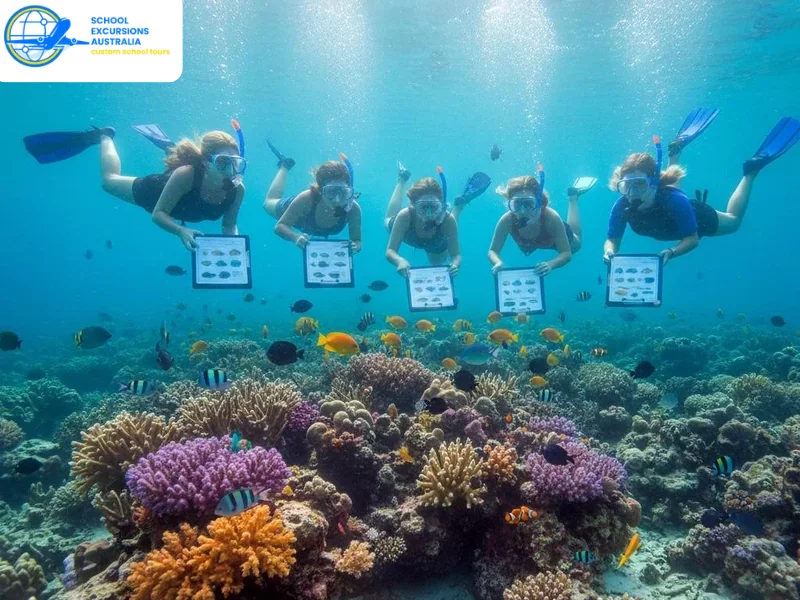
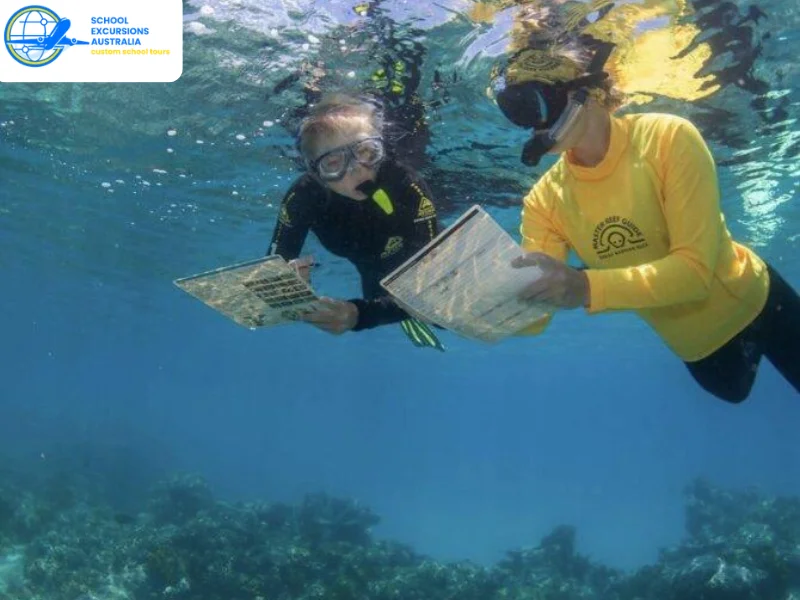
Students can use waterproof slates, field notebooks or teacher-supplied image sheets to record:
- Fish numbers within an agreed observation period
- Different body shapes or feeding behaviours
- Coral growth forms
- Areas of sand, seagrass, rock and coral
- Water movement and visibility
- Evidence of human activity
- Damaged or stressed reef environment
The students should view at a proper distance without touching or standing on the reef area. Taking photographs may help in identifying these factors if it is allowed.
How Can Students Compare Two Reef Areas?
Comparison prevents the activity from becoming a general description. Two groups might observe locations with different depths, exposure or habitat structure.
Field factor | Site A | Site B | Question to consider |
Water movement | Calm or exposed | Calm or exposed | Which organisms cope with stronger movement? |
Habitat cover | Coral, sand or seagrass | Coral, sand or seagrass | Where is the greatest variety visible? |
Fish activity | Number and behaviour | Number and behaviour | How does habitat affect fish behaviour? |
Human use | Low or high | Low or high | What pressures may visitors create? |
The table gives students evidence they can analyse after returning to school. They can explain patterns rather than simply reporting what they saw.
What Does Coral Structure Have To Offer As Lessons On Adaptation For Students?
Coral colonies have different shapes: one group consists of branching corals, one of plate-like corals, massive corals, and encrusting corals. All these types respond differently to light, sediment and water currents.
Students do not have to remember all kinds of coral. It is more effective to relate the shape that students see to the function in the environment.
For instance:
- Branching helps to make shade for smaller life forms.
- Massive round shapes can resist wave power better.
- Plate shapes provide a larger area for lighting.
- Encrusting growth takes place near the surface of the reef.
Thus, adaptation can be discussed without any hints at the intentionality of changes in living organisms; traits that help survival and reproduction of the organism become widely spread in a certain environment.
How Can Reef Fish Reveal Ecosystem Relationships?
The study of fish can serve as a practical example in the study of food chains and interdependence of organisms in relation to their habitat. Various body types, mouth shapes, and movements can give information on how the fish lives and feeds.
A narrow body can help a fish move among coral branches. A mouth directed downwards can point to surface forage, while streamlined fish can swim mostly in open water.
According to the Australian Institute of Marine Science, reef fish play an important role in maintaining corals’ health by performing various activities such as grazing, cleaning, etc. The studies conducted at Ningaloo in the framework of the Reef Song project explore how the sounds from the reef can help fish find a proper habitat.
The teachers can use this information to show that the presence of coral alone does not mean a healthy reef.
How Can Students Study Marine Science Without Entering the Water?
Not every student will be able or willing to snorkel. A strong program should include ways to participate from shore or through interpretation activities.
Possible alternatives include:
- Glass-bottom boat observation
- Shoreline habitat mapping
- Marine debris surveys
- Coral and fish identification activities
- Water-temperature comparisons
- Underwater video analysis
- Visitor-centre displays
- Food-web construction using observed species
The Milyering Discovery Centre offers display, audiovisual material, and information on the Ningaloo Coast World Heritage Area. It could also be used for briefings prior to the fieldwork, species interpretation and subsequent discussion.
They provide an opportunity for teachers to have the same learning outcome regardless of the swimming capacity of individual students.
What Can Marine Megafauna Add to the Learning?
Ningaloo is famous for the whale shark, the manta ray, turtle, dolphin, and the humpback whale. While these creatures have the ability to excite you, the class lessons should not only be about seeing them since there is more to learn.
The reef’s seasonal productivity supports the arrival and movement of large marine animals. An estimated 300 to 500 whale sharks gather in the wider region each year around the period of coral spawning and increased food availability.
Students can examine:
- Why some species migrate
- How feeding opportunities influence movement
- Why breeding and nesting are seasonal
- How scientists identify individual animals
- Which tourism rules reduce disturbance
- Why reliable sightings cannot be guaranteed
This turns the potential meeting of animals into a lesson on behaviour, season and scientific investigation.
How Should Turtle Nesting Be Taught Properly?
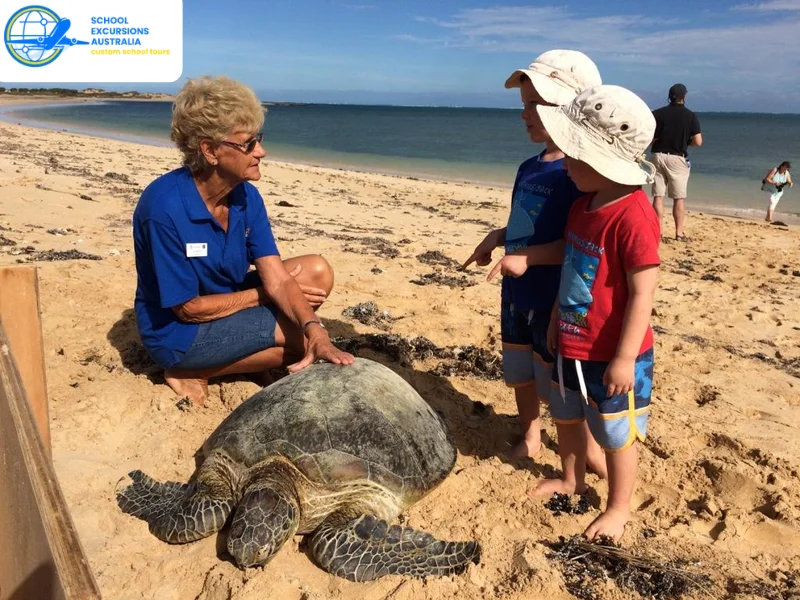
Three kinds of turtles are available in the coastal areas around Exmouth. Adults might come out onto the beach to nest, and the baby turtles will go into the sea.
Turtles depend greatly on light, sound and movement. It is essential for the learners to learn the observing protocol prior to reaching the nesting area.
Important behaviour includes:
- Remaining with the guide
- Keeping noise and movement low
- Avoiding flash photography
- Following restrictions on torches
- Keeping a suitable distance
- Never touching adults or hatchlings
- Leaving tracks, nests and eggs undisturbed
A guided eco-education experience is more suitable than an unstructured beach visit. It gives students accurate information while ensuring the activity follows local conservation requirements.
Why Should Cape Range Be Part of the Science Story?
Ningaloo’s educational value is not limited to the water. Cape Range makes it possible to compare the effective reef with the dry land environment.
The limestone range is filled with caves, underground water systems and the special animals that live under the ground. Its geological processes document the earlier levels of the sea and the long history of the peninsula.
A combined land-and-sea investigation can ask:
- How do organisms manage limited freshwater?
- Which features reduce heat and water loss?
- How does limestone influence the landscape?
- Why are some cave species found nowhere else?
- How are the reef, coast and range connected?
- What management pressures affect both environments?
This contrast helps students recognise that a World Heritage area can protect connected natural systems rather than one famous attraction.
How Might the Knowledge of Traditional Custodians be Incorporated?
There are cultural links to the Ningaloo Coast for the Traditional Custodians. Cultural teaching must occur using appropriate resources or from the Traditional Custodians or Aboriginal programs.
Sea Country consists of links between people, sea animals, seasons, coast, and culture. Sea Country is not considered another topic that must be taught in addition to environmental education.
Students need to be prepared in terms of:
- Why cultural authority matters
- How seasonal knowledge supports caring for Country
- Why some places, stories or practices may be restricted
- How scientific and cultural knowledge can contribute to environmental care
- Why students must follow guidance around significant places
The Australian Government notes that Indigenous people are the primary source of information about the Indigenous heritage values of the Ningaloo Coast.
How Should Schools Plan a Safe Reef Program?
Planning school trips to Exmouth WA requires more than confirming a tour time. Water conditions, heat, sun exposure, remote travel and student confidence must all be considered.
Schools should confirm:
- Student swimming ability and water confidence
- Activity-specific supervision requirements
- Instructor qualifications and provider insurance
- Snorkel equipment fitting and hygiene
- Weather and marine-condition limits
- Sun, heat and hydration procedures
- First aid and emergency communication
- Accessibility and alternative activities
- Transport time between locations
- Seasonal wildlife activity
- Park access and sanctuary-zone rules
Schools remain responsible for following their education authority’s excursion, risk management and consent requirements. Provider documentation should support the school’s planning rather than replace it.
What Should Students Bring?
Requirements will vary by activity, but a typical list may include:
- Broad-brimmed hat
- Reef-safe sun protection
- Refillable water bottle
- Long-sleeved sun-protective clothing
- Secure footwear
- Towel and dry clothing
- Personal medication
- Field notebook and pencil
- Waterproof bag for wet items
Families should receive the equipment list early. Schools should also arrange support for students who do not own specialised items.
How Can Students Protect the Reef During the Visit?
Environmental responsibility should be demonstrated throughout Exmouth marine education for schools, not limited to a final discussion.
Students should know that a low-impact visit involves:
- Keeping fins and feet away from coral
- Leaving shells, animals and rocks in place
- Using marked access points
- Following sanctuary-zone restrictions
- Securing food wrappers and equipment
- Avoiding wildlife chasing or crowding
- Listening to local guides
- Reporting damage without handling it
Students can also assess how visitor management works. Moorings, access paths, sanctuary areas and group limits provide real examples of how recreation and conservation are balanced.
Should Coral Bay Be Included in the Itinerary?
Excursions in Coral Bay could be appropriate for longer programs as it provides yet another convenient stopover location along the Ningaloo Coast. But care must be taken before including it in any tour program that is being planned from Exmouth.
The second location should definitely have some educational value to it; for instance, comparisons of different habitats or different levels of reef use. Including Coral Bay just to add to the list will only limit the duration of observations and cause unnecessary tiredness.
For a shorter program, one focusing just on Exmouth and Cape Range, better educational results might be achieved.
Conclusion
The students have the opportunity to employ their findings from the field to complete any of the following activities: habitat comparison, food web, reef management plan, or scientific explanation. The follow-up activity would be one where they analyze their observations and not just present the common facts about Ningaloo.
In order to plan for an excursion in Exmouth, teachers may first want to examine Exmouth destination information from School Excursions Australia before proceeding to discuss possible sites and activities that could be done in different seasons.
FAQs
It is important for the provider to have alternatives to shore, boat or interpretation activities that cover the same objectives.
No, although certain conditions can increase the possibility of seeing specific wildlife, it is impossible to control the movements of the wildlife and the weather.
The collection of such natural items is allowed only if the exercise is officially sanctioned.
It is advisable to have a plan B that both the school and the provider agree on for water activities.
A single observation activity per site is usually better than a full worksheet.
