Handwritten licences, muddy mine shafts or a single piece of gold on a pan show exactly why history seems closer than a written date in a book. This is the reason why Ballarat school excursions have such educational significance. The students will be able to see how geology brought thousands of people to the goldfields in Victoria and how migration and political conflict took place due to mining rights.
It is possible to say that Ballarat school excursions make history and science complement each other. The tales of the Gold Rush explain what made people come, while geology will show why there was gold there. There will be enough topics for history, geography, science, civics and environmental studies.
Why is Ballarat Not Just a Gold Rush History Destination?
Poverty Point hosted its first discovery of gold in 1851. Within one year, about 20,000 miners were working in the Ballarat goldfields. This fast population expansion had an effect on settlement, transport, trade, public service and politics.
This expansion offers more for students to study than just mining. They can ask questions about why transient camps transformed into permanent settlements, the way immigrants adjusted to living in goldfields and the reasons behind the miners’ rules.
A visit can explore several connected themes:
- The geological conditions that allowed gold to form
- Migration during the nineteenth century
- Working and living conditions on the diggings
- Law, taxation and representation
- Trade, technology and skilled labour
- Environmental effects of mining
- The experiences of women, children and First Nations peoples
Rather than approaching each topic individually, educators can structure one investigation based on a larger question, namely: “How was the hunt for gold responsible for transforming Ballarat and Victoria?”
What Can Students Learn from Ballarat School Excursions?
The most effective educational programs provide learners with an issue to study instead of a catalogue of activities. Ballarat is consistent with this principle because concrete sites, historical information, demonstrations and written materials are all capable of offering varied evidence.
A group investigating the Victorian Gold Rush might analyze a letter of a miner and a recreated streetscape. Another group, on the other hand, would look at a diggings map and consider the impact of water, soil and minerals on the decision of people about their workplace.
This encourages students to ask:
- Who created this source?
- What does it reveal about life at the time?
- Whose perspective is missing?
- Does another source support or challenge it?
- What can the physical landscape tell us?
- Which conclusions are supported by evidence?
These questions move the visit beyond observation. Students begin to work as historians, geographers and scientists.
How Can Students Research the Gold Rush Era?
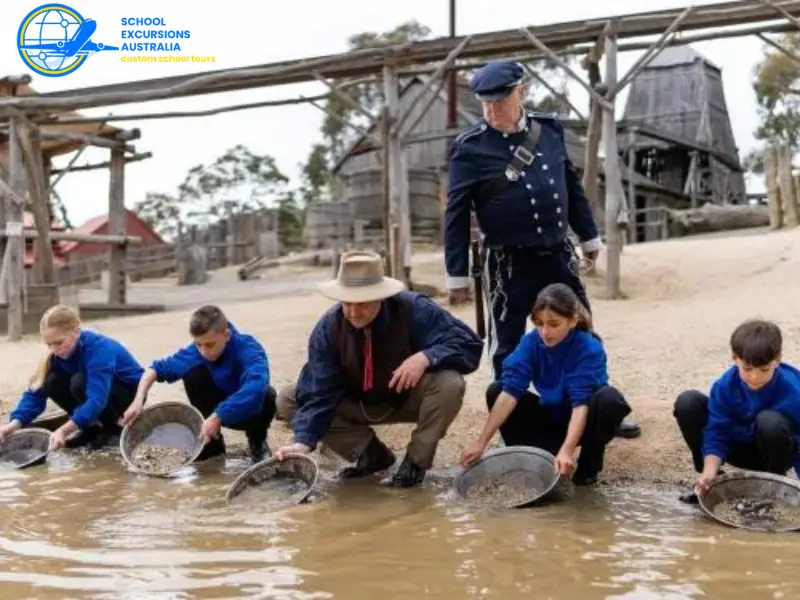
Students can experience life on the nineteenth-century gold fields through a Sovereign Hill school visit. Costumed interpreters, working demonstrations, buildings and collections provide concrete reference points for topics that can otherwise feel distant.
Sovereign Hill’s school programs focus on the 1850s Gold Rush and its environment, with indoor, outdoor, above-ground and underground learning experiences. Programs are available across different year levels and curriculum areas.
How Did People Live and Work on the Goldfields?
Everyday life offers a readily available starting point, especially when dealing with primary children. Clothing, accommodation, cooking, schooling, and work patterns reflect the different living standards based on age, profession, and social standing.
Students might examine:
- The materials used to build early shelters
- How food and water were obtained
- Which jobs supported the mining community
- How children were educated
- How illness and injury were treated
- Why sanitation became a public concern
A productive comparison is not simply “then versus now.” Students should consider why conditions differed and which economic, technological, or social factors produced those differences.
How Can Historical Sources Strengthen the Visit?
Recreated settings enable students to see history, but primary documents help them judge history. Photographs, government documents, maps, private correspondence, and news stories all have the ability to present viewpoints that may be hard to convey in a re-created setting alone.
The Public Record Office Victoria has material on the Eureka event, which consists of several outdated documents related to Eureka and the Ballarat time. The information contained within the Eureka trial also includes references to the famous 1854 uprising and events associated with individuals involved in the rebellion.
Teachers may offer two brief written resources to the students before the visit and require them to study them again at his return. Their interpretations may change once they have seen the scale, layout and conditions of the goldfields.
How Does Geology Explain Ballarat’s Gold Story?
The Gold Rush began with human ambition, but the story starts much earlier with geological processes. Gold deposits formed over immense periods before erosion and water movement made some of that gold accessible to miners.
Resources Victoria identifies Ballarat as one of Victoria’s major historic goldfields. The state has thirteen goldfields that have each produced more than one million ounces of gold.
There is thus a natural link formed between earth science and history. It is essential to study how geology determined settlement patterns, techniques, and the way the economy progressed.
What Can Gold Panning Show?
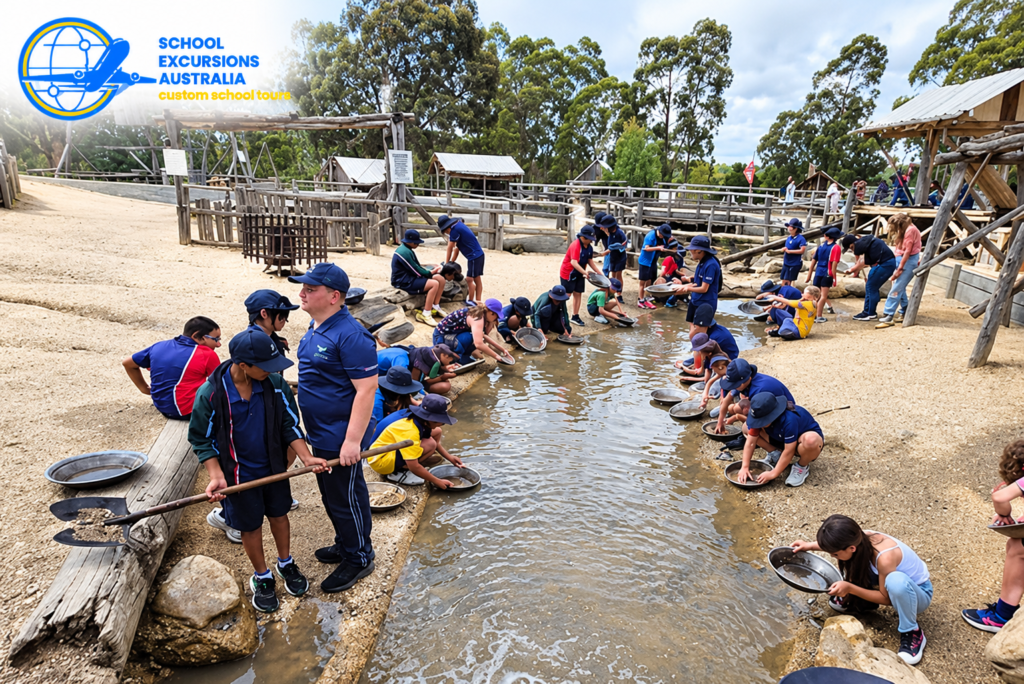
Gold panning is not only exciting, but it also gives students a lot to learn. The water signifies a whole theory of density and separation of sediments: while the heavier items go down, the lighter items get washed away by water.
Students can record:
- Which particles move first
- Where heavier material collects
- How water speed changes the result
- Why repeated washing is required
- How the method differs from underground mining
This small experiment can lead into a larger question about technology. If panning was slow and suitable only for certain deposits, what tools and engineering methods were developed as easily reached gold became harder to find?
How Can an Underground Experience Support Science Learning?
The underground mining environment facilitates understanding among students with respect to the topics related to rock formation, extraction of the ore, lighting, ventilation and drainage. The method of mining does not merely rely on chance, as it needs knowledge of geology, engineering, and machinery.
The program “We Built this City on Rock and Gold,” provided by Sovereign Hill, investigates the geology of the area of Ballarat, studying how gold was formed and the function of water in gold formation and extraction in great detail.
Moreover, the teachers may organize a preparation for their students involving either preparing a diagram of a mine or performing an elementary activity comparing the properties of rocks and minerals. In such a way, the students will convert all the theoretical knowledge into a number of practical situations.
Why Should the Eureka Story Be Taught Through Questions?
The Eureka Stockade is commonly viewed simply as a single battle involving a few prominent names. It is better, however, to try to understand the reasons for the conflict, whose interests it served, and how things evolved afterwards.
Students can investigate competing viewpoints:
Perspective | Questions students can explore |
Miners | Why were licence fees considered unfair? |
Government officials | Why did authorities enforce the licensing system? |
Police and soldiers | What responsibilities and pressures shaped their actions? |
Business owners | How did conflict affect trade and community stability? |
First Nations communities | How had colonisation and mining already changed Country? |
Later historians | Why has Eureka been interpreted in different ways? |
This approach introduces civic concepts such as representation, authority, protest, rights and responsibility. It also shows students that historical significance is debated rather than fixed.
What is the appropriate way to incorporate perspectives of First Nations?
Wadawurrung Country is where the city of Ballarat is located. Therefore, lessons learned as a result of the Gold Rush need to include the recognition that this area was neither ‘empty’ nor devoid of people and culture.
The colonization of this area and mining brought serious disruption to the environment, rivers, food and the life of the local community. These impacts shouldn’t just be presented in a quick introductory paragraph and separated from the rest of the program. They belong in the appropriate sections discussing land use, migration, law and changes in the environment.
Teachers should use materials that were created by or made in consultation with Traditional Owners whenever possible. Questions may include:
- How did mining alter waterways and landscapes?
- What happened when large populations occupied Country?
- Which historical accounts have traditionally received the most attention?
- How can students identify gaps in the written record?
- Why does the cultural authority of a source matter?
Sovereign Hill acknowledges the Wadawurrung people as the Traditional Custodians of the land on which it operates and recognises their continuing culture and the effects of colonisation.
How Can a Goldfields School Trip in Victoria Connect Several Subjects?
A goldfields school trip Victoria program does not need separate history and science days. One well-framed investigation can connect multiple curriculum areas without making the itinerary feel crowded.
For example, a question about why Ballarat grew so quickly could involve:
- History: migration, settlement and the Gold Rush
- Science: gold formation and material properties
- Geography: landforms, resources and environmental change
- Civics: licences, protest and political representation
- Economics: scarcity, trade, labour and population growth
- English: interpreting letters, reports and persuasive accounts
- Mathematics: timelines, population data and measurement
The link between subjects should remain visible. A geology activity explains where mining occurred, while historical evidence shows how people responded to the opportunity and its consequences.
What Do Educators Need to Prepare Before Visiting Ballarat?
Effective school trips to Ballarat should start from the educational goals and not a schedule. As soon as the main question is defined, teachers can choose activities that will produce evidence of answers or an experience regarding this question.
What Are The Points to Check with the Venue?
Before booking, schools should check:
- Programs available for the relevant year level
- Curriculum links and expected learning outcomes
- Session duration and group capacity
- Accessibility and mobility requirements
- Indoor alternatives during poor weather
- Arrival, parking and coach arrangements
- Lunch, water and toilet facilities
- Photography and supervision requirements
- Equipment or clothing students should bring
Program availability and program arrangements can vary, so all information should be verified independently and not relied upon solely from an earlier itinerary.
What School Requirements Need Attention?
All educational establishments must follow the established rules for excursions determined by the supervising body of their educational system. Steps of the business include getting authorization, obtaining consent of the parents/guardians, providing the medical information, ensuring supervision, arranging means of transportation and performing risk management.
Risk assessment has to be performed based on the program being implemented. In this regard, the following factors may be taken into consideration: underground sites, presence of rough terrain, weather conditions, presence of crossings, crowds of people and possibility of students walking away from their group.
Students also need to be instructed before the trip. Some of the information that is necessary includes the rules regarding proper behaviour, one must follow the instructions from the guide, one must know how to handle the artifacts, and stay within the assigned group along with some of the questions that can be asked on the trip.
How Can Teachers Prepare Students Without Revealing Everything to Them?
The preparation process must create interest rather than make unnecessary investigation unnecessary.
A focused pre-visit lesson could include:
- A map showing Ballarat’s location and goldfields.
- One historical photograph or letter.
- A short explanation of how alluvial gold is separated.
- A class-generated list of questions.
- Individual field notebooks with two observation tasks.
With this, students come with sufficient background information to interpret the experience but still have unanswered questions.
How Should Learning Continue After the Visit?
The return to school is where observations become evidence. A worksheet completed during the day is useful, but it should lead to analysis, explanation or evaluation.
Students might create:
- An evidence-based response to the central inquiry
- A labelled diagram explaining gold extraction
- A comparison of two goldfields perspectives
- A map showing how mining shaped settlement
- An environmental impact assessment
- A museum label for a selected object
- A short argument about the significance of Eureka
The teacher could also encourage the students to pinpoint an idea that changed after the visit. This would allow them to analyze how new information and first-hand experience affected their ideas.
Conclusion
Ballarat’s most effective learning activity entails investigating the cultural history, geology and society of the place. Students would be able to ask questions pertaining to the discovery of gold, migration, community development and issues of governance.
In organizing school trips to Ballarat, the teachers are advised to formulate a single inquiry question at the beginning and plan the appropriate activities in order to find the answer to the question. Schools should refer to the School Excursions Australia website for information on destinations.
FAQs
Book as early as possible, particularly for Term 2 and Term 3 visits. Confirm program times, group limits, accessibility, lunch areas and coach arrangements before finalising transport.
Some education programs include an underground mine tour. Schools should confirm access conditions, mobility requirements and whether the experience is appropriate for students who are uncomfortable in enclosed spaces.
Equipment is normally supplied as part of the activity. Students should wear enclosed shoes and follow instructions because the ground around panning areas may be wet or uneven.
Many activities can continue in light rain, so students need waterproof clothing. Teachers should ask the venue which sessions are indoors and what changes will be made during severe weather.
Keep fieldwork focused. Ask students to collect three useful pieces of evidence, such as an observation, a sketch and a quote from a historical source. This is easier to use after the visit than a long worksheet.
