Australian alpine landscapes give students first-hand experience of distinctive landforms, changing weather systems, fragile ecosystems and tourism infrastructure. When schools plan outdoor education, alpine regions provide an effective setting for connecting geography lessons with direct observation.
An alpine program can combine physical and human geography in one experience. Students can examine how elevation affects weather and vegetation while also investigating the influence of tourism and recreation on the environment.
Why Outdoor Education Alpine Regions Support Geography Learning
The alpine environment is a good example of how the interplay between environmental forces and human choices takes place.
A geography program may examine:
- How elevation affects temperature and vegetation
- Why snow cover changes between seasons
- How slopes and valleys influence water movement
- Why alpine plants require specialised adaptations
- How tourism supports regional communities
- How recreational activity affects sensitive environments
- How land managers balance access and conservation
- How climate change may influence future snow conditions
These topics become clearer when students can examine physical evidence rather than relying only on maps, photographs and classroom explanations.
Geography Topics Students Can Investigate
Landforms, Gradients and Elevations
In alpine regions, there is a possibility for learners to study the following land features: ridge lines, valleys, gradients, and drainages, which will assist them in comprehending the relationship between contour lines and the real landscape.
Students may complete activities such as:
- Drawing annotated field sketches
- Identifying natural and modified landforms
- Comparing exposed and sheltered slopes
- Recording changes in elevation
- Using maps or coordinates to locate features
- Examining how roads and buildings respond to terrain
Older students can compare their field observations with digital maps and satellite images. This allows them to assess how accurately different geographic tools represent the landscape.
Weather, Climate and Seasonal Change
Changes in temperature, wind, precipitation, and snow occur rapidly in alpine areas. Students may make use of this diversity to look into how weather and climate differ.
Some effective inquiry questions are:
- Why is it usually cooler at higher elevations?
- What is needed for snow to form?
- How does the wind affect the exposed slopes?
- How is snowmelt involved in the formation of rivers and catchment areas?
- Why is the time span of the snow season different?
- How do the changing seasons impact tourism and jobs in the area?
The comparison of the winters and green seasons will show that alpine areas are diverse and constantly changing rather than always snowy environments.
Ecosystems and Biodiversity
Alpine ecosystems in Australia have flora and fauna that have adapted to cold temperatures, windy conditions, seasonal snow and short growing seasons. Such ecosystems can be impacted by weed growth, fires, trampling, development and climate change.
Investigating biodiversity can be done through:
- Recording vegetation types
- Comparing disturbed and protected areas
- Looking for signs of animal activity
- Examining soil moisture and ground cover
- Identifying evidence of erosion
- Mapping visitor movement
- Discussing threats to native habitats
Fieldwork should remain observational. Students should stay on approved routes, avoid disturbing wildlife, and follow instructions relating to environmentally sensitive areas.
Tourism and Human Impact
The alpine resorts offer excellent illustrations of the connection that exists between geography and tourism. The roads, places of accommodation, walkways, ski-lifts, snow-making machinery, and tourist services demonstrate how humans alter their environments for recreational purposes.
Students can consider:
- Why resorts developed in particular locations
- How visitor numbers change throughout the year
- What services are required during the snow season
- How tourism benefits nearby communities
- What environmental pressures tourism creates
- How waste, water and transport are managed
- How resorts prepare for changing climatic conditions
An alpine school camp Victoria program can therefore support both physical and human geography. Students see how environmental conditions influence economic activity and how human decisions affect the landscape.
Suitable Destinations in Victoria’s Alpine Regions
Victoria’s managed alpine resorts include Falls Creek, Lake Mountain, Mount Baw Baw, Mount Buller, Mount Hotham and Mount Stirling. Each has different terrain, visitor facilities and seasonal activities.
Potential fieldwork settings include:
- Mountain villages and resort precincts
- Lookouts and designated walking routes
- Snow-covered recreation areas
- Alpine grasslands and woodlands
- Water catchments and drainage areas
- Visitor-management infrastructure
- Natural areas affected by seasonal change
Alpine Resorts Victoria manages Victoria’s six alpine resorts and provides information about their environmental, recreational and operational characteristics. Teachers can consult Alpine Resorts Victoria when researching locations and current conditions.
The destination should be selected according to curriculum outcomes, student needs, accessibility, travel time and seasonal suitability.
Winter and Green-Season Learning
Winter Geography Activities
Winter snow school excursions Australia programs can combine geography fieldwork with supervised snow activities. Depending on the location and approved itinerary, students may participate in:
- Weather and snow observations
- Guided landscape walks
- Snow safety education
- Cross-country skiing
- Snowshoeing
- Beginner skiing or snowboarding lessons
- Field sketching and photography
- Studies of winter tourism
These activities allow students to examine how snow affects movement, recreation, infrastructure and environmental management. Schools must follow relevant excursion and adventure-activity requirements whenever snow sports are included.
Green-Season Geography Activities
Warmer months reveal landforms, vegetation and infrastructure that winter snow may conceal. Students may also have more time to complete detailed fieldwork without managing snow equipment.
Green-season activities can include:
- Bushwalking on approved tracks
- Vegetation surveys
- Topographic mapping
- Waterway observations
- Soil comparisons
- Tourism-impact assessments
- Landscape photography
- Studies of erosion and land management
Green-season visits demonstrate that outdoor education alpine regions programs can operate throughout the year. They also allow students to compare seasonal uses of the same destination.
Skills Students Develop During Alpine Fieldwork
Geographic Data Collection
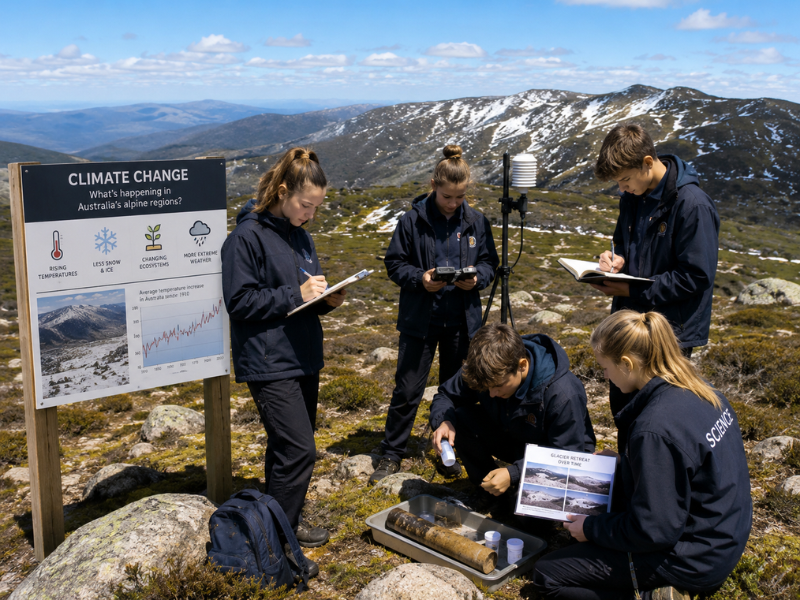
Students can gather primary information by recording observations, preparing sketches, taking measurements, and comparing different sites.
Their evidence may include:
- Written field notes
- Weather observations
- Annotated photographs
- Vegetation records
- Topographic sketches
- Visitor-impact surveys
- Maps of facilities or environmental features
Collecting evidence in the field teaches students to distinguish between observation and assumption.
Critical Thinking
Alpine geography rarely presents simple answers. Increasing tourism may support regional employment while creating additional environmental pressure. Infrastructure may improve visitor safety while modifying the natural landscape.
Students must consider different perspectives, assess evidence, and explain their conclusions. This supports more thoughtful discussion of sustainability and environmental management.
Teamwork and Responsibility
Field activities usually require students to work in groups, share equipment and complete tasks within a defined period. Overnight programs can also strengthen organisation, independence and personal responsibility.
Environmental Awareness
Direct contact with an alpine landscape helps students recognise why responsible behaviour matters. Staying on designated tracks, managing waste and following local instructions become practical environmental actions rather than abstract rules.
Planning School Trips Alpine Victoria
A successful excursion begins with clear curriculum outcomes. Teachers should identify what students are expected to learn before selecting activities or confirming an itinerary.
Set a Focused Inquiry Question
A central question gives students a clear reason to observe and collect information.
Examples include:
- How does elevation shape an alpine environment?
- How has tourism modified this landscape?
- Why are alpine ecosystems vulnerable?
- How do managers balance recreation with conservation?
- How could changing snow conditions affect local communities?
One focused inquiry question is generally more useful than a long worksheet containing unrelated tasks.
Connect Activities With the Curriculum
Outdoor education alpine region experiences may support geography topics including:
- Landforms and landscapes
- Weather and climate
- Environmental change
- Water resources
- Tourism
- Sustainability
- Human impact
- Place and liveability
Relevant science, health and physical education outcomes may also be incorporated where they genuinely support the program.
Prepare Students Before Departure
Preparation should cover the educational purpose, environmental conditions and expected behaviour.
Students may need to:
- Review maps of the destination
- Learn relevant alpine vocabulary
- Examine weather forecasts
- Practise field-note techniques
- Understand minimal-impact behaviour
- Learn how to use fieldwork equipment
- Review clothing requirements
- Discuss emergency procedures
Teachers should also explain that weather or access conditions may require changes to the planned schedule.
Alpine Excursion Safety Requirements
Alpine environments require careful risk planning because weather, visibility, temperature and surface conditions can change quickly.
Planning should address:
- Staff supervision and qualified instructors
- Transport and mountain road conditions
- Accommodation and overnight supervision
- Weather forecasts and emergency warnings
- Warm and waterproof clothing
- Appropriate footwear and equipment
- Student medical and dietary requirements
- Communication where reception is limited
- Emergency contacts and evacuation procedures
- Alternative activities when conditions change
The Victorian Department of Education advises schools to consider student age, experience, group size, location, activities and anticipated weather when determining supervision. Adventure activities may also have specific staffing and instructor requirements.
Teachers should review the latest Victorian Government excursion supervision guidance during planning.
Extending Alpine Learning in the Classroom
The excursion should produce evidence that students can analyse after returning to school. Follow-up work helps them connect field observations with broader geographic concepts.
Students could:
- Prepare an annotated field report
- Compare winter and summer landscapes
- Map tourism infrastructure
- Analyse weather observations
- Evaluate the environmental effects of tourism
- Design a low-impact alpine itinerary
- Present a land-management recommendation
- Explain how changing snow conditions could affect the region
Teachers can also ask students which observations challenged their expectations and what additional evidence they would collect during another visit.
Creating Learning Out of Alpine Landscapes
Fieldwork education in the alpine zone helps students study landforms, ecology, climatology and tourism based on observations. A good fieldwork trip will develop students’ geographic fieldwork skills, critical thinking, teamwork and environmental awareness.
Steps to start with include setting learning objectives for the curriculum, comparing seasonal activities and practical needs of each destination. Exploring suitable alpine regions for school excursions is the next step towards selecting a program that turns geographic concepts into meaningful field evidence.
FAQs
Yes. Students can study landforms, vegetation, waterways, erosion and tourism infrastructure during warmer months.
Students can collect weather readings, field sketches, photographs, vegetation notes and observations of visitor impact.
Requirements depend on the season, but warm layers, waterproof outerwear and suitable closed footwear are essential in changing mountain conditions.
Schools should have an alternative activity and follow advice from the venue, transport provider and relevant emergency authorities.
Students can prepare a field report, compare locations, analyse collected data or recommend ways to reduce environmental impact.
